Thessalonians 4

Part 4

Through most of this letter, Paul consoles and encourages the Thessalonians. In the beginning of this chapter, Paul is encouraging them to grow in holiness. Paul has no bone to pick with them; but rather, he knows the trials they will have to endure and wants them to be prepared… lest they lose their faith. He mentions things from the Ten Commandments and the proper way of living justly toward one another and with others. Their example in such matters is foundational. In the same way, we today must have the basics of faith in the Ten Commandments memorized and lived. Without the adherence of such basics, growth in holiness is not possible.

We think that we have reached the pinnacle of perfection when we finally live out the Ten Commandments. Most of us will be shocked to hear that obeying the Ten Commandments is just the novice level in the spiritual life. The Ten Commandments says nothing about loving God and your neighbor, or of living out the beatitudes in Matthew chapter five. It says nothing about redemptive suffering and offering up that suffering for the greater glory of God. It says nothing about forgiving and even loving even your enemy.

Yet, how can we do that without getting the basics of the Ten Commandments right? Is living out this paragraph even possible? Only when a person has faith in Jesus and relies on Him for all the graces needed.

This brings us to a case in point dealing with death and suffering; the very reason for why Paul is writing encouraging them to holiness. They have concerns for those who have died in their faith. They were members of the community and dearly loved. Losing one person in a community is hard enough, but to have many die in the faith community— that is hard to accept.

Paul takes a little time to teach them about the second coming and the promise of eternal life (13-18). Paul gets detailed about the second coming. He states, “…God will bring forth with Him from the dead those also who have fallen asleep believing in Him” (v14). So when Jesus comes, He will raise from the dead, alongside those who will participate in eternal life. This repeats in verse sixteen as, “…the Lord Himself will come down from heaven at the word of command, at the sound of the archangel’s voice and God’s trumpet; and those who have died in Christ will rise.”

When Jesus comes again, He will come down in the physical sky. There will be a manifestation where many people will witness as Jesus comes down in the sky. This chapter does not clarify if it means all people, or merely the chosen selective. This verse also mentions that there will be a trumpet blast and/or the angel’s voice to accompany this reality. When God’s speaking is described to sound like that of a trumpet, we do not know if it will be both or if the angel will also sound like a trumpet. It is also not specific if it is just the heavens that will hear the voice or trumpet, or if it will be heard by humans. This chapter has nothing conclusive about those questions.

Some people ask, “But what about those who are still living?”  This chapter does say something about that. Verse seventeen says, “Then we the living, the survivors will be caught up with them in the clouds to meet the Lord in the air. Thenceforth we shall be with the Lord unceasingly.” By stating, “the survivors,” this insinuates the trials that are found in many other scriptural passages. We assume the trials are over by the time we meet the Lord “in the air,” so this applies to the very end of times, not before any time of peace that may have been prophesied. This says nothing about the survivors going through any death. The assumption here is that they would not die, but go on living.

In addition, assuming they do survive, purgatory may be during their suffering through the trials. Once they meet the Lord in the air, the survivors will also never again leave the presence of God. This is the destiny for those who remain in faith. It is consoling to know that God has made this promise for those who desire to be with our loving God.

Father Barr

*From the March 13th Bulletin

Thessalonians 3

Part 3

Paul writes with his heart in chapter three. He reveals his true character and his inner disposition; as well his thoughts and feelings about the difficulties at hand. In his fatherly heart, he is anxious and even “shaken” by the trials of his children. He is under suspense as he is not able to be there with and for them. Though Paul cannot be there, he sends Timothy to Thessalonica.

Paul sends Timothy so that he can find out how well the faithful are enduring their suffering. He also wants to encourage them and give them words of comfort and strengthen them with any words he can give. You can sense Paul’s sheer passion behind all of the doting he does over the children. Moreover, Jesus Christ inspires this passion. He is concerned for the people’s faith. He is concerned for their eternal life. What good is it to have children if they do not eventually get to heaven…? It would be painful to see them suffer eternal punishment. We all die at one time or another. Some of us die earlier than others. Is it better to die later, only to go to hell? Paul is concerned for both their lives and their souls.

In this letter, you start to see the community behind Paul that responds with mutual care. Even though they go through their own trials, they are caring for one another. They do not abandon their faith in favor of an “all man for himself” mentality. A community of mutual love and support is firmly growing there in its place. In fact, it seems that the suffering they all endure together makes them stronger. They are there for each other and they suffer with each other in unity. They make the decision to suffer together rather than alone, and this is what bonds them in their love as a community. Jesus came to establish a church, not a book. Jesus brings life to the church while we are there for each other. He fills his people with the Holy Spirit all the more while He suffers.

This is how the Church and the people within it become fruitful, in cohabitation to our relationship with God. We start to grow in holiness and grace as God teaches us how to sacrifice for the good of each other. We are more and more inspired by the grace of God in our lives and by the people in our faith community. Their faith and suffering benefits the rest of the community as the rest of the community inspires faith in those suffering. God granted us that gift of togetherness when He created His holy church. This is why the mentality of “just Jesus and me” was never part of God’s plan for us. God never meant us to be alone in faith. As Satan knows all too well, “divide and conquer.” Through baptism, we are born again into a family of believers.

It is so important not to separate ourselves from the love of God that exists in this community. Every one of us has a role to play in God’s plan of love and sacraments. The other person in the pew is not a stumbling block, but an opportunity of love. If not today, you never know the goodness that may come in the future. But this is a message for those who have eyes to see and ears to hear. Do you have the faith to open your heart to God? Is your heart open to see the faith in your community and to love your family in faith?

Father Barr

*From the March 6th Bulletin

Thessalonians 2

Part 2

In the second chapter, Paul gives his heart to the Thessalonians. He reflects upon his experience with them, and notes that they bring him hope. In this explanation, he reveals a little about how the conversion of the Thessalonians comes about. It was not by flattering words, greed, or the pretext of gaining glory (2:5-6). Paul simply speaks to truth and the Holy Spirit did the rest of the work.

This should remind us today that conversion with the faith does not happen because of the eloquence of the tongue. Eloquence may help, but does not make it happen. As humans, we have no silver bullet by ourselves. God, who works in the hearts of the people, prepares the soul to receive His grace.

Many people think that we have to get the numbers of people in the pew up. That is the observable mark that they consider the most important. It’s a goal that demonstrates how simplistic our minds can be. If we see more people in the pews, then surely the church is becoming more successful. In that end, we are tricked by flash in the pan reality. Just having more people in church doesn’t really measure success. All of those people also have to commit themselves. Meeting an observable goal may look good on paper, but if no substance is given, you may even end up with fewer people. The Catholic Church that Jesus Himself founded has been given the task to preserve the faith that Jesus has given us. When I went into the seminary, a friend of the family gave me a hat that read, “Jesus is my boss.” This is very true, but Jesus is also more than that. Jesus is also my Master. He has absolute authority over me as an individual. He especially has absolute authority over me as a priest. I have an obligation to do His holy work, which is to preserve the truth and bring the sacraments to His people among other things.

Jesus left the deposit of faith and the Catholic Church has preserved it for two thousand years. We are His servants. The Church has also been given the task to preserve our worship. There may be many people who think we have to change things to make us more “likeable” or to catch up with the times. This thought has no historical basis in the church. The Church does not change to the whim of the world. God expects the world to change into His conformity.

This conformity is innocence, purity, and goodness as a child of God. How do we make our lives “worthy of the God who calls” us to His glory (v12)? First, we have to listen to the word of God attentively (v13). This is spoken or written. Take note of the way Paul inscribes this. What the Church teaches does not come from man, but from God. Man contemplates this reality and discovers ever deeper of how it affects our lives.

In conclusion, we do not learn more by leaving the teachings of Jesus Christ, but rather by pondering the same reality. Changing things up to make the church more appealing goes against what Paul teaches us to do. I thank God that we have Paul to keep us guarded from falling into false teachings. We all need that help.

Father Barr

*From the February 20th Bulletin

Thessalonians

Part 1

Before Paul writes to those living in Thessalonica, he writes first to Timothy, the bishop in the area that Paul himself ordained (2 Tim 1:6). Religious historians believe that he wrote this letter in Corinth. It was not long after Paul had visited Thessalonica that he wrote his letter. We believe that Paul wrote this letter in the year 51 or 52, because Gallio was Proconsul at the time, and Paul mentions this fact (Acts 18:12). Reading chapter 18 of Acts of the Apostles can give you an idea of what Paul was going through as he writes this letter.

Many people were dying and despairing. It was not an issue of people not having faith in God and His goodness. Rather, they had a misunderstanding of what was taught. They thought that the second coming was going to happen soon, and that people had to be alive in order to participate in the final placement in heaven. This puts clarity on what Paul is trying to explain and makes more sense of the text on the latter part of Chapter 4.

Paul begins with his usual greeting and praise of God in the first chapter. He thanks God for the Thessalonians, and he prays for them (v2). Paul has been preaching to every community, but he has also been diligently living out an example by which to show others how God wanted them to live. Paul did this everywhere he went. The Thessalonians seem to be one of the few places that got the full message; not just the words given, but the example as well (6). In many of Paul’s letters, he pointed out the way of life he lived as he was there.

 Actions speak louder than words. Yet at the same time, they can easily go un-noticed. As Americans, we often focus on the what. We think of teaching as somebody in a classroom writing on a board, and telling us the knowledge we need to know. But learning is much more than that. Real learning, especially when it comes to our faith, delves deeper than what words alone can contribute. Action is one of the tools that can convey what words cannot. Actions allow us to see what virtue looks like. It also gives us an experience of the goodness of virtue and it inspires us to follow that goodness. Action strengthens us as well. The more good actions we do, the easier it becomes to stick with it. Though the devil sometimes challenges us and makes things more difficult, we still gain strength from undergoing the hardship.

People lived out their faith and gave up all the falsehoods they used to follow before. They gave up all idol worship (9). They made the decision to follow God and to worship Him alone. There was no fulfilling purpose in sticking to past worship, nor was there a true fire to live on just entertainment. The people did not make their own religion the way they wanted it. They followed God as He is and had a desire in their own hearts to serve Him alone. This is where the power of God is shown.

The Gospel message is lived out and souls are saved. Actions are undeniable. It can speak lies or truths from our body language alone. Do our actions speak of how God is merciful and loving? Do our bodies speak of virtue and goodness? Our bodies are where the Word is to be made flesh (Jn 1:14). Our very bodies become a temple created to serve the goodness of God. Living with the Holy Spirit opens our minds and hearts to the gifts that God has given us.

Father Barr

* From the February 13th Bulletin

Nine-Day Novena Prayers

9 DAY ST. JOSEPH NOVENA

The Prayer of Saint Joseph (Prayed at the end of each daily reading)

O God, who in thine ineffable providence was pleased to choose blessed Joseph for the spouse of thy most holy Mother, gran we beseech thee, that we may be worthy to have him for our intercessor in heaven whom we venerate as our protector on earth.  Who livest and reignest with God the Father in the unity of the Holy Spirit, God, world without end. Amen

First Day – Thursday, March 10

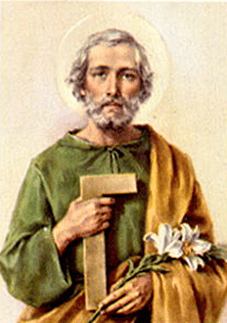
The man nearest to Christ Jesus was His foster father, Joseph the carpenter.

            John the Baptist saw Christ briefly near the dan and knew that his work as Precursor was over.

            The Apostles lived and worked with Christ during the brief days of is public life.

            But Joseph presided over the events of Christ’s Infancy, provided for Him the house that sheltered Him from birth to baptism, and was of all the men of earth the one at whose hands Jesus received most in service and love and unselfish devotion.

            Born of a royal line, Joseph was a carpenter. That trade he passed on to his foster Son, Joseph was destined to immortal honors of the Church, yet no spoken word of his is recorded in the scriptures.

            Still the Church with good reason cries out, “Go to Joseph.”

This injunction we confidently obey as we pray:  (The Prayer of Saint Joseph)

Second Day – Friday, March 11

There is always a cause for the choices God makes.

            Out of the long procession of men through history, God selected Joseph to be the husband of Mary and protector of the Savior.

            Joseph’s youth was one of stainless virtue.

His young manhood was marked by deep religious faith and a burning desire to see the Savior of Israel. His was a life of honest work and of a humility that fitted him for his part in the hidden life of the Savior.

            Little did he dream as he visited the synagogue on the Sabbath that someday he would be the protector of the synagogue’s God. Little did he understand that the trade of carpenter that he was learning would be the means by which he would provide food and clothing for the world’s maker, would be the trade that he would teach the creator of the universe.

            Without knowing what it was that he was getting ready for, he gave to his simple jobs the full devotion and the full strength of a character of a simple, honest man.

            In these ordinary ways did he fit himself for the extraordinary assignment that God would give him.

            Remembering this splendid man, who walked the simple ways we pray: The Payer of Saint Joseph.

Third Day – Saturday, March 12

Tradition has it that Joseph had taken the vow of virginity, thus renouncing the right to marriage.  At any rate he lived a life of purity.  He was stainless among men and pure in the sight of God.

            But God in His providence had greater designs for Joseph than mere abstinence.  He chose Joseph, the just man, for the delicate mission of sheltering Mary’s virginity and at the same time being her loyal spouse and guardian of the Incarnate Son of God.

            Legend tells us that he was selected by a miracle: The barren rod that he held in his hand blossomed with lilies. Perhaps. But surely his soul was bright with joy when he knew that God had given him to be the partner of his life the rose of Sharon the stainless lily of Israel, the flower among all the flowers in God’s garden.

            He accepted his bride and his new responsibility with the determination to make her happy, to keep her happy, to keep her safe, and in her company to carry out whatever were God’s plans for their future.

            So Joseph and Mary were married, and they established the holy house of Nazareth. There they lived most exemplary lives.

To this strong and pure protector of Mary they pray: The Prayer of Saint Joseph

The Prayer of Saint Joseph (Prayed at the end of each daily reading)

O God, who in thine ineffable providence was pleased to choose blessed Joseph for the spouse of thy most holy Mother, gran we beseech thee, that we may be worthy to have him for our intercessor in heaven whom we venerate as our protector on earth.  Who livest and reignest with God the Father in the unity of the Holy Spirit, God, world without end. Amen

Fourth Day – Sunday March 13

Wedded to the loveliest of brides, entering marriage with strong ideals and a trust in God’s provident care, Joseph had a right to expect love and security that come with consecrated marriage.

            While marriage for him was the beginning of a high honor, it was also the beginning of a new pain. While it added to his royal dignity, it was also the occasion of poverty, patience, exile, obscurity, confusion and wonderment.

            For at once he found that his virgin bride was with child. What could this possible mean? He wanted to think her stainless, but what of this clear evidence? He was confused and bewildered. And while it was distasteful to a man of his simple reticence, the law of his people demanded that he put her away.

            Since Mary herself did nothing to enlighten him (for she was committed by God t secrecy his confusion gave way to grave doubt, and doubt in turn gave way to firm, honorable resolve to take action.

            Hat a period of suffering and suspense this must have been to Joseph.  In His own good time, God would reveal the wonders of the incarnation of His Divine Son. But to prepare his soul for so great a miracle, God chose to cleanse his heart in suffering.

Remembering his trial and suffering, we pray: The Prayer of Saint Joseph

Fifth Day Monday, March 14

Pain and patience in the service of Christ and His Mother soon turn to joy.

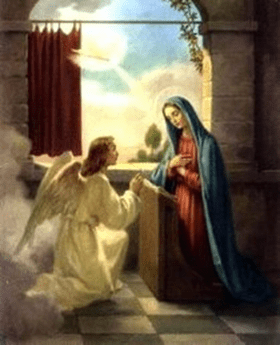
            The visit of the angel brought an end to Joseph’s problems.

            The Child who the lovely Mary carried was the Son of the Most High. He had no earthly father, for God Himself was His Father. The Holy Spirit had wrought the wonder in Mary’s body.

            Over Joseph there came in a rush the realization of what his marriage meant.

            He among all men of earth was to be the guardian of the Mother of the Savior.

            Upon him would rest the responsibility to protect the Christ Child, to provide His home, to watch over His childhood, to lead Him into the safe maturity that would be a prelude to His public life.

            The home? Joseph had only the house of the carpenter to offer. The food of the Son of God would be plain. The clothes He wore would be those of a laborer’s child. But Joseph silently vowed that the Christ should never want for a heart to love Him, for hands to serve Him, for feet to run His errands, for a back to shoulder whatever weight God would let him bear. Joseph and Mary smiled upon each other and together waited for the coming of the Son of God, the Savior of the world.

          To Joseph, guardian of Mary and protector of the Infant Savior, we say: The Prayer of Saint Joseph

Sixth Day – Tuesday, March 15

To us Christmas is a day of uninterrupted joy.

            To Joseph it was a day of the brightest light and the deepest shadows: a blazing sky and a chilly cave; the presence of angels and the cold shoulder of the villagers; faith and sorrow; intensest joy in the Infant and grief that he could give the Infant only a stable and straw and his ineffectual service.

            The story of Joseph and Christmas is dearly familiar to us.

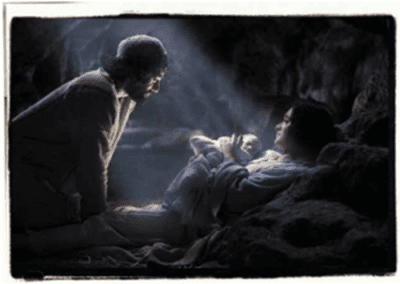
            It was decreed that they leave the comfort of home and journey to Bethlehem. The doors of the crowded inns were slammed in his face. He quested through the night until he found the cave and prepared it for his bride and for the coming Child.

His was the joy of hearing the song of the angels and watching the procession of the first adorers. His was the pain of seeing Mary shiver in the cold darkness and of remembering that they had been forced to leave in Nazareth the cradle that he had made with such loving care.

            He was the first sentry in the court of the new king, His first man-at-arms, s prime minister, His treasurer, the faithful disciple of the master, who had yet to speak His first word.

To Joseph at Christmastide we say: The Prayer of Saint Joseph

Seventh Day – Wednesday, March 16

Compared to the powerful and important Herod, Joseph was in the eyes of his times a nobody.

Joseph was in the eyes of his times a nobody.

            Yet as this faithful carpenter and saint made smooth the ways of his Lord, worked for His comfort, and knelt to adore Him, Herod plotted the destruction of this Child, whom he looked upon as a possible rival for his throne.

            Herod had tried to turn the Magi into messengers of death, but these wise men had on a warning from God, through the star-lighted night found their way to the king.  Failing this, Herod sent his soldiers out to kill the Child and end the threat to his brief ad pitiful power.

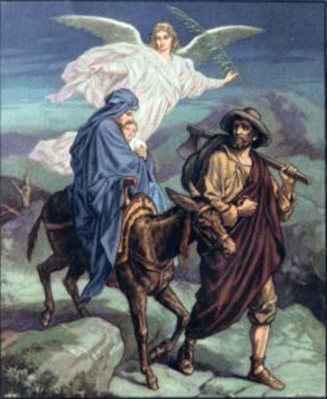
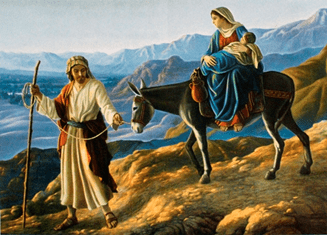
            Another visit of an angel…and Joseph is moving through the night, leading the ass that carries the sacred burden of Mother and Child.

            Eyes alert for danger, staff gripped tightly against possible threat, feet tirelessly striding forward, a few coins in his purse, his locked shop left behind him, Joseph travels the glorious and ignominious road to exile.

            But God had chosen well when He chose this protector of Mother and on. The journey was safe, the exile comfortable, and the return happy and secure.

To Joseph, guardian of Jesus and of Mary in danger and in exile, we say: 

The Prayer of Saint Joseph.

Eighth Day – Thursday, March 17

Wonderful things have happened in the long annals of mankind, but none have been more wonderful than what occurred in the little house and shop of Joseph in Nazareth.

            The earnings of a laborer provide the food for the creator of heaven and earth.

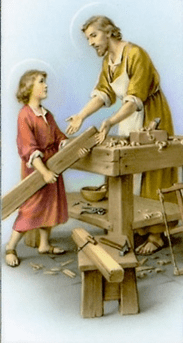
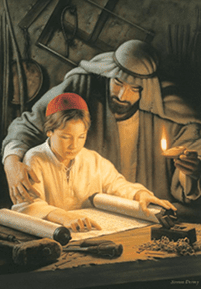
            Into the little carpenter shop comes the young Jesus, apprenticed to a trade.  Joseph guides the hands that guided the course of the stars; he teaches the maker of sun, stars, and planets the craft of making tables and chairs for peasants and yokes for oxen.

            The Trinity looks down to the lovely trinity of heart – Father, Son, and Holy Spirit beautifully mirrored in Joseph, Mary, and Jesus.

            Modern Christian homes receive their design and pattern from this model.

            Modern Catholic marriage is here given its lovely example.

            Childhood learns obedience as the young Jesus obeys the commands of his parents.

            The hearts of Mary and Joseph create a union close and dear and intimate and utterly beautiful; together they live and think and plan and work for the Child, who has been given into their keeping.

            Theirs was a beautiful family.

Remembering the happiness of Joseph in Nazareth, we pray:

The Prayer of Saint Joseph.

Ninth Day – Friday, March 18

Death in the days before Christ was often frightening, often terrible.

            It was left for Joseph to show us for the first time the perfect way to die.

            Graciously God let him know that his work was done. Jesus was almost ready to enter His public life; in that the humble carpenter would play no part.

            He obeyed the voice of God in death as he had obeyed that voice in life. But for him the voice had no terrors.

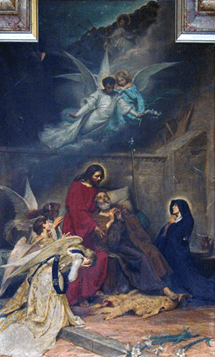
            As Joseph lay on his bed, Jesus and Mary were close to him. His head rested on the virgin breast of his untouched bride. His hand rested in the firm grasp of his foster Son. Jesus was speaking gratefully of what Joseph had done for Him. Mary was saying a loving thank-you. His thoughts were being lifted up…and up…and up toward the heaven that lay ahead and the glory that comes to those who have done their simple duty well.

            Jesus and Mary followed their beloved protector to the grave.

            In his place in glory the whole Church has sought him, called him its faithful guardian, and known that from his powerful intercession favors past counting fall upon the world of men and women, whom he regards as his beloved sons and daughters.

            To Joseph in Heaven we say: The Prayer of Saint Joseph.

*Provided by Cynthia Saar
Prayer for the Ukraine

God of Mercy,
We pray for Ukraine.
For all of humanity distorted by war.
For all the lives lost, homes seized and peace broken.
May the Spirit of comfort and compassion envelop all who dwell in fear.
May the Spirit of wisdom and humility enliven our global leaders.
May we affirm the dignity and rights of all.
May we seek peace.
Amen.

Mary’s Prophecies by Brian Murphy: A Warning Before War

Ukraine

PRAYER POINTS

VIDEO

• Pray for God’s peace and reconciliation to overcome all hatred, conflict, and war.

• Pray for followers of Jesus to arise as messengers of His hope to the hopeless and the oppressed.

• Pray for repentance, forgiveness, and unity in the Church, across denominations and traditions.


SUMMARY

Once one of the Soviet Union’s most fertile republics, Ukraine was a major producer of Europe’s wheat and a primary source of minerals such as coal and iron. The country’s rich, black soil generated more than 25% of the Soviet’s agricultural output. Since gaining its independence in 1991, the nation has struggled to take advantage of its economic potential and remains largely dependent on Russia for oil and gas. And while Ukraine has become a mixture of ethnicities, traditions, and customs, Ukrainians continue to be a very hospitable people.

During the seventy-one years of Soviet rule, Ukraine endured engineered famines in which an estimated eight million died. The government strictly limited attempts to develop Ukrainian culture, even forbidding the study and use of the Ukrainian language. The nuclear meltdown at Chernobyl in 1986 continues to inflict environmental damage, disease, and death.  In 2013, after the government abandoned close trade ties with Europe for more favorable ties with Russia, massive protests began with hundreds of thousands in attendance. When the government passed anti-protest laws, the protests escalated into deadly riots. Though these laws were later annulled, fighting and unrest continued across Ukraine, resulting in a civil war that has since taken thousands of lives. In the midst of this internal chaos, Russia annexed Crimea, adding further confusion to an already divided nation. Attempts at peace and reconciliation have been largely unsuccessful. In addition, the population suffers greatly from HIV/AIDS and alcoholism. Rampant drugs, crime, and prostitution enslave many of Ukraine’s most vulnerable, including orphans.

As the “Bible Belt” of the former Soviet world, the Ukrainian Church has faced a long history of persecution. Though freedom of religion is improving, it is not yet protected in both law and practice. Leadership training and direction are greatly needed among Christians, especially with the rapid growth of thousands of new congregations since 1991. Doctrinal schisms in the Orthodox church and divisions between Catholic and Protestant believers hinder their witness. The pain suffered under Soviet rule and during the most recent conflicts has greatly divided the Ukrainian people. But even amid recent violence, the Church has responded as the hands and feet of Jesus, meeting physical and spiritual needs. This has provided increased opportunities for Ukrainians to know and follow Christ.

If you ask me anything in my name, I will do it.  – John 14:14

Read more at;

https://www.prayercast.com/ukraine.html

https://www.americamagazine.org/faith/2022/01/26/pope-francis-peace-prayer-ukraine-242284

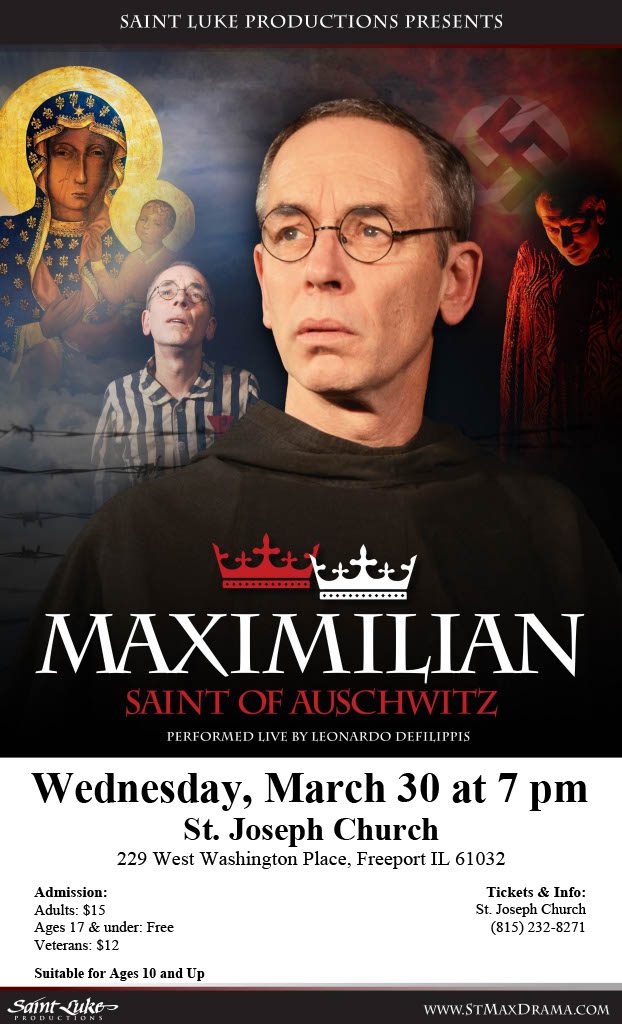
Maximilian Saint of Auschwitz Performance

“This very day begin to serve God…. Live it as if it were, indeed, the last day.” – Maximilian Kolbe

‘Our companion this Lent will be a saint less than a century removed from our times: Maximilian Kolbe, Polish patriot, Franciscan priest, founder, friend, ecumenist, publisher, missionary, and martyr. In the end, his body was reduced to ashes, becoming little more than the smudged cross on our forehead on Ash Wednesday. Kolbe’s beginnings were unremarkable, the middle son of devout Catholic parents who were weavers by trade. In his retreat before priestly ordination, Maximilian jotted down a long series of terse notes to himself, many about remaining in the moment using it well, honoring the woman of faith he treasured most: Mary. Write a word or sentence now about your intention this Lent, not so much a resolution as a desire to journey this Lent with a hero who can encourage and inspire you. What is that choice?’

Praying with St. Maximilian

‘Saint of our times, guide us to recognize and embrace opportunities to increase our spiritual stamina. You relied on the Blessed Mother. We take her for our own.’ (Lent with Maximilian Kolbe, Daily Reflections by Carol Ann Morrow)

Learn more at;

https://www.stlukeproductions.com/

The Production

(A summary by St. Luke Productions)

Maximilian: Saint of Auschwitz is a dramatic one-man Catholic theater performance by Leonardo Defilippis. The play opens when the young Raymond Kolbe expresses his desire to be a priest. In spite of the trials he encounters as a seminarian, the Blessed Mother sustains him in his journey. In a vision, she offers him the choice between two crowns – one of purity or one of martyrdom. He boldly chooses both. This now sets the stage for the unfolding of the intense plot. In this tour-de-force performance, Defilippis switches effortlessly from Maximilian Kolbe to Nazi, alternating dramatically between good and evil. The audience is drawn into the compelling events of this courageous life and into Kolbe’s message of trust. Maximilian is completed by a breath-taking musical score. Our updated version of the play also includes projected images and newsreels of Nazi Germany. This historical footage makes the story come alive in a visceral manner. Now, perhaps more than ever, Maximilian has a special relevance for our time. The play offers an engaging reflection on the dangers we face in the current attack on religious freedom. This story is one of sacrificial love and of martyrdom for the Catholic Church. Defilippis says, “Saint Maximilian Kolbe has a powerful, yet cautionary, message for all of us – not to take the freedoms we cherish for granted, but rather to defend them with our lives.” Maximilian premiered at the 1993 World Youth Day in Denver before an audience of 2500. In honor of the opening, Leonardo Defilippis received a special plaque of Saint Maximilian. It was signed by Francis Gajowniczek – the very man for whom Fr. Maximilian offered his life in Auschwitz! Defilippis also performed at World Youth Day 2000. There, several thousand young people witnessed the production at the Basilica of Our Lady of the Angels and Martyrs in Rome. Countless people of many faiths and walks of life have seen this production. Audience members have included survivors of Auschwitz, former Nazi soldiers, and several who were in the very same lineup with Fr. Kolbe that fateful day. Brother Jerome, the personal secretary to Saint Maximilian, saw the play at age 83. Several seminarians who worked directly with Fr. Kolbe have also witnessed this live drama. Over the years, Leonardo Defilippis has had the privilege of performing in many different venues. He was especially honored to perform for Mother Angelica and her Poor Clare Sisters in a private performance. Saint Mother Teresa of Calcutta gave her personal blessing upon this show and wanted her sisters to experience it.

Reviews

“I had a beautiful and wonderful re-encounter with our Mother, the Immaculate Conception, whom I had abandoned. I am very blessed and thankful for such a wonderful gift of faith and love.” ~ A.M., Huber Heights, OH
“I watched Maximilian at the Martyr of St. George nuns at Alton, IL about 25 years ago, and I can still hear you singing ‘Who are you, O Immaculate Conception? Who are you, and what would you have me do?’ Is that grace or what?” ~ Fr. H., IL
“I saw Maximilian as a young person in the 1980’s and can still remember the feeling in the pit of my stomach as he willingly accepted death so he could receive both his white & red crowns. It was at that moment I realized that Catholicism is not for wimps.” ~ S. B., Milton, WA

We need able bodied volunteers willing to sell tickets for the St. Luke Production of St. Maximilian Kolbe before the event arrives.  Anyone interested, please contact Cynthia Saar, Fr. Barr, or leave a message with Emily at the church office.  We gladly welcome your involvement in making your church parish events successful.

Please spread the word as much as you can! We hope to have a successful turn out.

Lent 2022 Schedule

Spiritual Events and Activities

Healing service

· March 6th at 2pm in SJ

Three-week Teachings with John Jelinek and John McGrath

· March 20th, 27th, & April 3rd

Crucifix Making

· March 26th, April 2nd & 9th in SJ Deleiden Room

St Luke Productions play: St Maximillian Kolbe

· March 30th, 7:00pm

Weekly Lent Schedule

·  Stations of the Cross 7:30pm in SM Spanish on Thursdays

·  Stations of the Cross 12:10pm in SJ every Friday

·  Holy Hour and Healing Service at 5pm in SM Church every Friday

·  Stations of the Cross at 6pm in SM Church every Friday

Holy Days and Sacrements

Ash Wednesday March 2nd

· 8am & 7pm (Spanish), in SM

· 8am & 5:30pm in SJ

· 9:30am in Ascension Care Center

Be Reconciled Day, April 6th

· 8-9am in SM

· 10:30-11:45am Provena

· 12-1pm in SM

· 1-4pm in SJ

· 5-8:30pm in SJ

· 6-7pm in SM

Holy Thursday April 14th

· 7pm in SJ

· 7pm (Spanish) in SM

Good Friday April 15th

· Veneration of the Cross 12pm SM

· 5pm Spanish in SM

· Viewing 3pm in SM

Easter Vigil April 16th

· 5:30pm in SJ

· 7pm (Spanish) in SM

Friday Night Fish Fry!

St. Mary Church in Freeport, IL will host a Fish Fry every Friday during Lent.

Located at the Holy Family Community Center, 725 S. State Ave.

From 4:00-7:00pm.

Carry-Out Only!

Holy Healing Service!

Sunday, March 6th @ 2:00pm

Please feel free to print or download this flyer to pass out at your local gas station, bar, eatery, and invite your family and friends to participate. Every extra pair of hands brings us closer to our vision of healing.

Flyers for this service will also be available in the church office.

Stay tuned for any additional changes to our Schedule.

And most of all- enjoy praying and attending our upcoming Lent events!