
Galatians 3:19-29

From verse 19 in chapter three Paul writes about the relevance of the law. He does so without the technical words that have been developed to this day. So, like many people in the past, these words could mean many things and be taken in another direction that was never intended.

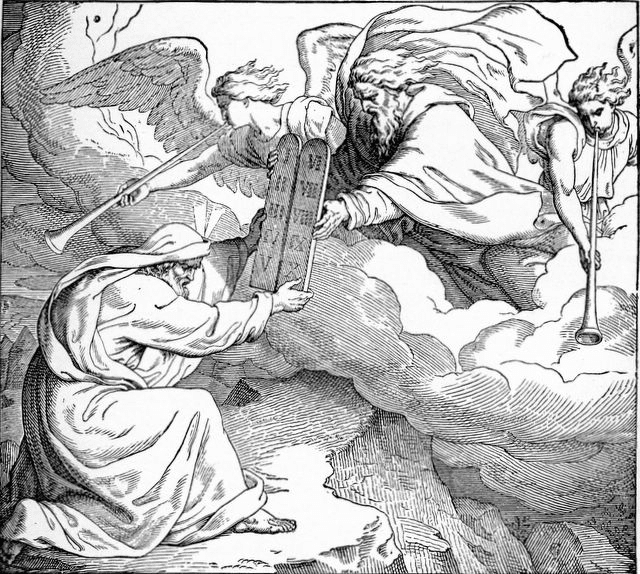
The Ten Commandments were given because of the many sins humanity was committing. Sin is a lack of goodness. We still have goodness; we just no longer have the fullness of goodness as God created us to be. God did not create us with this lack of goodness. We did it to ourselves by the sins of Adam and Eve and we ourselves continue this by our sins. All goodness comes from God. Therefore, humanity cannot make up for the lack of goodness in original sin, only God can. Original sin is an expression of that lack of goodness that we inherited from our first parents. We have a tendency towards sin. The soul now has ignorance which puts an imbalance to the three powers of the soul: the intellect, passions and the will. So God gave us the Ten Commandments to live by so that we would no longer hurt each other and ourselves by our lack of goodness. The obedience does not make up for the lack of goodness. It is there to preserve us from making things worse. What good is God’s mercy if we continue to offend each other and don’t even care? The lack of goodness would still persist.
Yet there would come a time when Jesus would come down to us and show us a way far superior to the Ten Commandments. It is the way of faith. The way of faith is concerned with not offending God by breaking the Ten Commandments, but even more so, how to please Him. Fear of offending makes a person shrink back from a relationship with the other, whereas pursuing the good for the other seeks a relationship with the other. This is what our faith should do. It is also what love should do. Fear of the Lord is the first stage of wisdom (Prov 9:10). It keeps us in right relationship with God’s mercy by obeying the Ten Commandments. But as we experience (which is knowledge) such goodness, we should have more confidence (which is faith) in goodness. This allows us to pursue the good that is lacking. It can only happen when we rely on our faith in God.

The Ten Commandments become the stepping stone to faith. How can a person say they have faith in God while they actively offend Him? To a person who has faith, they are no longer worried about offending God because they have come to know Him and are experienced at avoiding such things. The worry no longer consumes their minds so that they can focus on the goodness God desires. An athlete becomes good at what they do not by focusing on what hinders them, but by focusing on the good habits and filling their minds with good coaching and techniques.

At the end of this chapter, I must mention the promise of Abraham that is extended to all those who believe in Jesus (29). That is why the priest prays at the Mass when he does the Eucharistic Prayer I when he says, “Abraham, our father in faith.” When you reflect on the interaction Abraham was open to with God, you can see such great desire to please God. It was a sign of faith He had in God. A desire not to offend God is noble. Still greater is the one who desires to please Him.


Father Barr

Galations 3:10-18


Paul continues in the third chapter, to explain how a person cannot be saved by observance of the law.
He goes back to our understanding of what law is and its nature.
First, I must explain how some people think they might be saved by works or observance of the law by
itself. It really stems from our finite perspective. The idea of being finite comes from the fact that there
was a time when we did not exist physically, and there will be a time when we will not exist physically.
We were created by God. God makes sure of our continued existence and provides for our existence in
the future. This means that we are entirely dependent on God for everything.
Unlike us, God is Infinite. God was never created and in fact is existence itself. All being gets its existence
from God. God is the only infinite being. Not even the most powerful of angels hold this nature. Before
such an infinite being, we could be utterly crushed. By the very fact that we are finite, we have
insecurity issues. Our existence is really not in our control. That makes many people feel uneasy. Some
people may think that maybe they really can affect their salvation. Maybe, if they are good enough, God
could owe them this salvation. Others may think if they get in good, then they can earn or manipulate
themselves into God’s love. These two ideas offend God. They deny God’s goodness. It has nothing to do
with faith (v11). It is just another form of “knowing” they are saved.
We have to remind ourselves that while we have never even heard of God, God has created us out of
His love. Before God even created us, God loved us. It was not something we earned. It is a matter in
trusting in that love. We do not have to proclaim our faith, do any deed or obey any law for Him to love
us.
The Law has already condemned us while we were still yet sinners. That is the nature of law. When we
speed, we get a ticket and have to pay a fine. If we obey the law, then we simply are not penalized. It
does not make you an exalted citizen. You have just done what you were supposed to do (Lk 17:10). In
original sin, our human nature that we inherited has been wounded. The nature of this wound causes us
to sin, offend God, each other and ourselves. Out of love for us, Jesus chose to come down to humanity
so that we may inherit a new heritage founded by Jesus in Abraham (14).
If it is the promise given to Abraham that we inherit, then the old law is not wiped out. Rather, we
discover that the scriptures are fulfilled in the one who has become a curse for us (10-13). The old law is
fulfilled by Jesus taking the curse, then out of His goodness, fulfills the promise given to Abraham. The
law negated the promise for justice’ sake. Yet the Infinite One (God), who knows the sins to be forgiven
before it even happens, chose to give the promise to Abraham. He knew the price that would have to be
paid, before He would give the promise to Abraham. So the promise is not negated, by the grace of
Jesus Christ.
How long ago did he make that promise? How many years has Christ shown His kindness after the
resurrection? It goes to show the consistency of God. His love truly endures all things (1 Cor 13:7). This
allows us to truly have a free relationship with God, the Infinite One. We do not need to be afraid. In
God’s goodness, he calms our fears and our insecurities about our fate. It is a freedom that only love
itself can provide.

June Food Truck

The Society of St Vincent de Paul will sponsor the Northern Illinois Mobile Food Pantry Truck on Wednesday, June 16.
The food will be distributed from 10:00am to 11:30am in the east parking lot.

Again, this will be a drive-thru distribution; however, I have just received information that we will not receive pre-packed boxes, but will have to bag the groceries on site. Clients will not have a choice, but will receive a bag/bags of food as they drive through. Due to this change in procedure, I will need a minimum of twenty to twenty-five helpers. The truck will arrive at 9:00am with all of the food and supplies, including grocery bags. If you can help, please contact Mary Koppi at 815-232-4687. Thank You!

Navigating Your Way Through Grief

After an Unexpected Loss

Sue Hall, a prior Monroe Clinic on-call chaplain, has coordinated
a free lunch n’ learn on grief related to sudden  death. This event will take place on Thursday, June 17 from 11:00am – 1:00pm at 18th & 8th in Monroe. RSVPs are required. 

The presenter is Darcy Brunner, who is a licensed social worker with over 35 years of experience in mental health.

To RSVP, or if you have questions, call Sue at 608-
206-6916.