An elegant organ recital, an unforgettable experience, music of the soul
Sunday, October 3 at 2:30 pm at the United Methodist Church, 2227-4th Street, Monroe, WI.
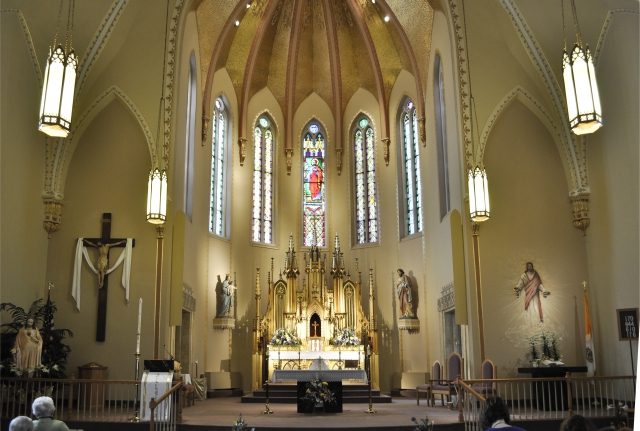
Eight Monroe and Madison-area organists will present an hour-long organ recital on Sunday, October 3 at 2:30 pm at the United Methodist Church, 2227-4th Street, Monroe, WI. Sponsored by the Association of Church Musicians and Madison Chapter of the American Guild of Organists, the annual event is a fundraiser for the Ruth Pilger Andrews Organ Scholarship Fund, for which a free-will offering will be accepted. The public is invited to attend. Masks will be required; there is ample room in the sanctuary for distancing.
The Scholarship Fund
Ruth Pilger Andrews (December 8, 1905 – July 29, 1996), a distinguished Madison organist and teacher of organ.
Supporting the foundation ensures that beginning organists have a space to learn and excel in the world of music. The organ produces a sound unlike any other, and it’s haunting beauty has been in church tradition for generations. Attending and giving to fund raisers such as this is the best way to spread that beauty for everyone.
Paul continues with the image of the domestic church; the family. Children are to obey their parents. (v1). Obedience is the primary means by which children honor their parents when they are younger. Paul reminds them, “’Honor your father and your mother’ is the first commandment to carry a promise with it…” (2). It is a commandment from God as given on the tablet to the people of God. The first three commandments deal directly with God and not offending Him most directly. The other seven deal with how we treat our neighbors, who are made in the image and likeness of God. The first commandments come first as they are the most important. The first of the commandments dealing with others is honoring our parents. This is yet another sign of the home being the sanctuary where God is discovered in the love spouses have in each other and the love children discover in their parents. “Fathers, do not anger your children. Bring them up with the training and instruction befitting the Lord” (4). The Father in Heaven loves the Son with such purity and fullness. The Son in turn loves the father also with such purity and fullness. In a similar way, children are to love their parents and parents are to love their children.
Slavery still exists today. India and China are today’s land of slavery. I am not talking about slavery in figure of speech. Actual slavery does exist. So the message to the slaves does apply to slaves today, but they can also apply to us. Slaves suffer more than those who are free. Most people would agree on that. If those who suffer so greatly have things required of them, then we should listen ourselves as to God’s will. It would give us a great clue as how to act and how to honor God by our lives. Paul instructs them to obey the slave owners. Obey willingly and with care. God is the one who will judge. Verse nine gets really strange; instructions for slave owners. Paul tells them to respect the slaves and do not threaten them. Paul reminds them the real “master in heaven… plays no favorites”. No person has anything that God is in need of. Their status in this life means nothing to God.
So often we think our enemy is each other. We get worried about this person or that person. We worry about political people or people of influence and what they may do to us. God will take care of them. God is our strength (10). Not only does God protect us, but He also arms us with His weapons. When in warfare, it is important to injure the enemy, and not cause injury by “friendly fire”. The army that goes out to do battle needs weapons meant for the enemy and that are capable to help them to victory. So in every war, you must make sure you know and understand who your enemy is. So who is our enemy? Paul says in verse 12; “Our battle in not against human forces, but against the principalities and powers, the rulers of this worlds darkness and the evil spirits in regions above.” Swords and guns are of no use against spirits, principalities and powers. Rather, Paul suggests truth as the first weapon against the weapon of our enemy, lies and deceit. As humans, we use our intellect to find truth. Then to seek our justice (14). Justice is in an act and is found in the will. Zeal is expressed in the passions, but is put forward as a way to peace. This is opposed to complacency that allows everything to run amuck and cause discord. Faith is the shield that protects us, especially when it is well integrated. Faith allows us to use these Godly weapons with prudence. It guides us in all matters as faith is instructed by God who knows all things. The promise of salvation protects us as we enter the battle. We know our Lord is trustworthy. He would never leave us in the battlefield. The Holy Spirit speaks through His holy words in the Bible. But the Holy Spirit is not limited to scripture. He works through the Church and His followers in prayer. In fact, Paul dedicates a paragraph to pray. Prayer is very powerful. Some people may wonder what cold be done in prayer. Prayer is a communication, particularly with God. God so happens to be the creator of all things. What He says goes. Now imagine that God would decide in your favor. Yes, prayer is very powerful indeed.
Opportunities are available for work at the retreat- or to plan a visit there yourself.
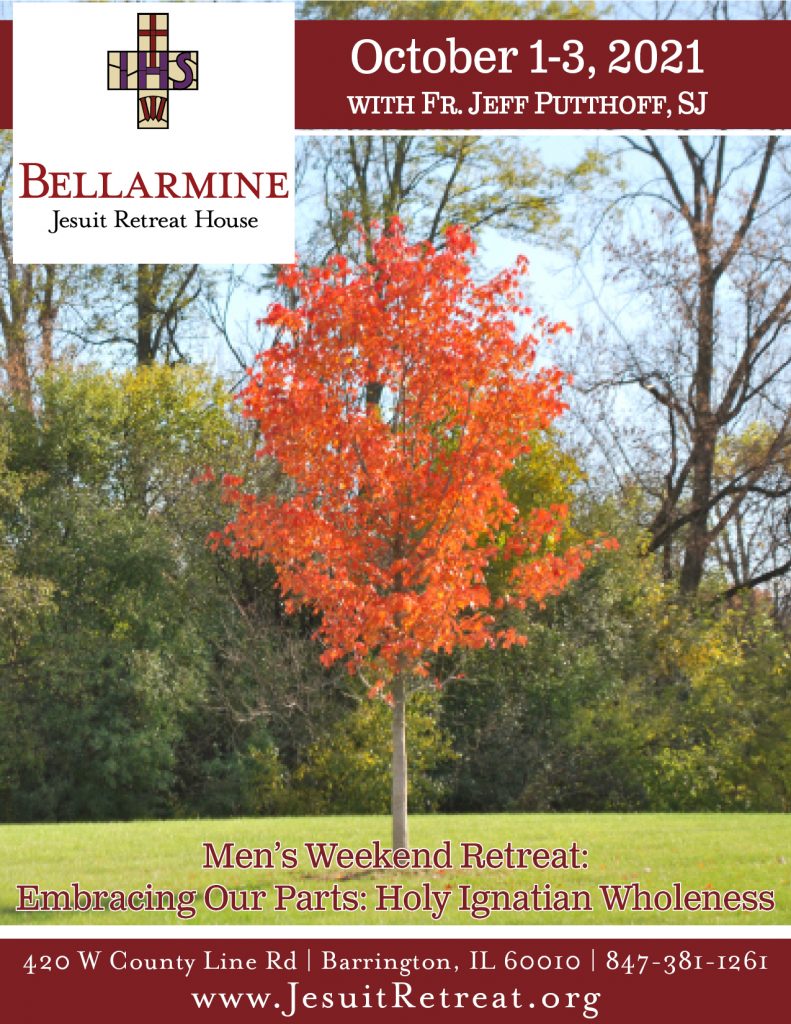
They are looking for hired help to take care of the property. There is also a Men’s Retreat coming in October. Mark your calandars if you are interested in checking it out!
Bellarmine Jesuit Retreat House
Located on 80 acres of gently rolling meadows and wooded countryside just 40 miles northwest of Chicago. Bellarmine offers Ignatian, silent retreats for men and women adapted from the Spiritual Exercises of Saint Ignatius. A wide variety of other retreat experiences are held at Bellarmine, including Kairos retreats for teens, 12-step retreats for those in recovery, as well as private and directed retreats. Jesuit and lay colleagues collaborate in planning retreats and spirituality programs. In addition, Bellarmine extends its hospitality to parochial schools, churches, and other partners in ministry and recovery programs that share in our vision and core values.
Bellarmine falls within Vicariate 1 of the Archdiocese of Chicago. While we are not a parish, we seek to serve the faithful of the Archdiocese and provide additional faith formation for parishioners in Barrington and the surrounding area. Visit Vicariate 1’s website for more information about other events in our part of the Archdiocese.
The Grace of Silence
Bellarmine Jesuit Retreat House maintains an atmosphere of silence so that you can hear God’s voice speaking the words your soul longs to hear. These days are God’s gift to you, a graced time for you to spend with the Lord.
If you are not accustomed to being silent on a retreat, we guarantee that you will find it restful, refreshing, and very easy to do!
While silence in your retreat at Bellarmine involves not talking to each other, it is more than that. It means quieting yourself on the outside and the inside so that you can be totally present to God.
Silence helps us let go of the preoccupations of the past and the anxieties about the future so that we can discover our deepest desires. It is in these deepest desires that God speaks to our souls and opens up new possibilities for our lives.
We remind ourselves that this letter is mostly about the Church, but this chapter conveys the link between the church, Jesus’ love for us and the love between spouses. Paul says, “defer to one another out of reverence for Christ” (v21). This is the Segway between church and marriage. We remind ourselves that the family is the domestic church. Matrimony is where life is born. This life gives birth to hope. It is called to be a place where love is found.
Paul gives a structure of the Church and marriage that may be offensive today. Most people hear the 22nd verse, “Wives should be submissive to their husbands…” and do not hear the rest. It is such a shock to us to read something like this. Before we get into all of this, we refer back to the previous verse to “defer to one another.” This shows the equality between husband and wife. Marriage is not something where dominance is the rule. They are equals. The other half of this verse goes deeper, “out of reverence for Christ”. As husband and wife, you are to see the dignity in each other. God has made each other as a gift. But they are more than a gift. God gives His very self in each other. There is a certain awe spouses should hold for each other. They are totally other, yet they have been made one flesh. The reverence they hold is for each other and for this special sacrament. This especially holds true where the grace of the sacrament is present.
The obedience of wives is understood as the obedience of all the faithful to Jesus. In this sort of parable, the wife is the Church as the husband is Jesus. Taking a step back again, the love between husband and wife is a living out of the love between Jesus and all the faithful. So every marriage conveys reality of the world and the gospel message of His love and mercy. This Church that submits to Christ includes the hierarchy; the pope, cardinals, all the bishops, priests, deacons and religious as well as the faithful.
Husbands are called to “love their wives, as Christ loved His Church” (25). How did Jesus do that? He died on the cross for the Church (He died for us, for you and me). Jesus was willing to suffer. Jesus purifies us. How? Through the sacraments in confession, the Eucharist, baptism and confirmation. God makes us holy and sees to it we are prepared to meet Him at the end of our lives. Hopefully we can look forward to that day when we would be united with God forever. I thank God for doing that. In a similar way, husbands are to help his mate remain pure of heart in the marriage and in faith. “Getting drunk on wine; that leads to debauchery” (v18) is not for the life of a husband. He must give up all such things.
Husbands are to “love their wives as they do their own bodies” (28). Paul is introducing a logical thought here. A person knows that they must take care of themselves. There are many people who do not take care of their bodies well. Yet we all know it is virtuous to make sure your health is good, keeping it in balance. Any man who has been married knows, if you are not attentive to your wife, you will feel it. It may be from her anger, or it may be from the pain she suffers. When one suffers, both suffer because they have been united in a very real way. The bond may not be seen, it is still there.
Our bond to Christ may not be seen, but it is still there. Though a husband may not be good at living out the love of Christ, Jesus never fails. “We are members of His body” and so are united to Him. As grace comes to us in the sacraments of the Church, grace also becomes an experience between spouses as they learn to love one another as Christ has loved us (Jn 13:34).
People with roots in Latin American countries have lived in the United States from its very beginnings. However, their presence on the national scene was practically invisible. The 1970 Census was the first time Hispanics were counted and recognized as a distinct population. The very term Hispanic was chosen by the U.S. Government to name a growing population that was not a racial or an ethnic group, but a people with roots in more than twenty-three Latin American countries and Spain, sharing a common cultural heritage and language. The term Latino emerged in the 80s as a self-given name, particularly in urban settings. This broadening of identity as Hispanics/Latinos was encouraged by robust immigration from Latin America during the ’80s and ’90s. Yet today, most Hispanics/Latinos still identify with their nation of origin, for example, and prefer to call themselves Mexican Americans, Cuban Americans, Puerto Ricans, etc.
The roots of the Hispanic/Latino presence in the U.S. go back to colonial times when most of the country’s southern flank was under Spanish rule. The first Mass celebrated in what is now the U.S. took place in 1569 in St. Augustine, Florida, under Spanish auspices. The Hispanic/Latino presence took on a whole new dimension in the 1840s with the annexation of half of Mexico’s territory to the United States as a result of the Mexican-American War. The new border crossed entire populations from big and small towns, as the Mexican-American presence was born in what is now the American West and Southwest. In 1898 the Spanish-American War led to the annexation of Puerto Rico, adding its population to the growing number of U.S. citizens of Hispanic/Latino descent.
The second part of the twentieth century saw a new wave of Hispanic/Latino immigrants come to the United States from Mexico, Central America and South America. In the early 1940s the U.S. and Mexico established the “Bracero Program.” This program brought thousands of Mexican nationals to work in agriculture. The demand for workers also brought a significant number of Puerto Ricans to the Northeast region. The ’60s saw a massive immigration of Cuban refugees as a result of the Cuban Revolution. The ’70s and ’80s witnessed significant immigration from Central America due to civil wars ravaging places like El Salvador and Guatemala. During the ’90s many Latin American countries experienced a severe economic crisis. Growing Fact of Faith unemployment and high inflation rates forced nationals from practically every Latin American nation to migrate north in search for better economic opportunities. Immigration from Colombia, Bolivia, Ecuador and Peru was particularly high during those years.
– This article is an excerpt from “Chapter Two: Hispanic/Latino Presence in the USA and the Church.”
We will need to cut back on our open hours during the week. Our new Secretary, Emily Morris, will be in Monday through Friday til 12:30pm.
We are looking for volunteers to come in on other hours. I invite you to think about how you can help.
We are looking for volunteers for the office to answer the phone and let people in. They would schedule mass intentions, contact the priest for anointing of the sick, get people signed up for the sacraments, help them fill out forms, and stuff bulletins. Taking the protecting God’s Children is needed for this volunteer position. The days that are needed are currently Tuesday through Thursday. What we do not get covered by volunteers, we will not be open those hours.
Unfortunately for us, our secretary has felt the call to move on to new adventures in her life. We will all greatly miss her here. Her presence has always been one of dignity, due diligence and peacefulness. I thank her for the good work she has done with such care and devotion. – Father Barr
Farewell & Thank You…
As I prepare to leave my position as secretary at St Joseph and St Mary Churches, I would like to thank the wonderful volunteers I have had the pleasure to work with and get to know over the past three and a half years. I am truly grateful for your kindness and support. I have enjoyed serving the parishioners here, and thank you for the appreciation and kindness you have shown me. Peace be with you all. – Barbara
God of love, We thank you for our wonderful grandparents. They bring such joy and happiness into our lives. Thank you for all the special times that we have with them. Please watch over them, protect them and care for them now. May they know your goodness and love always.
A Child’s Prayer for Grandparents
Dear God, please bless my grandparents. Thank you for the life they gave my parents and for the life, they give to me.
For the ways they helped me and made me strong, I give thanks. For the ways, they love me no matter what, I rejoice. For the ways, they have paved the road that leads me here, I am grateful.
Let them grow in wisdom and joy in life. Let them find peace and rest from their work. Let them be healed of every sickness and pain. And let them see with their own eyes your glory and the love of their children and grandchildren.
Bless them always until they come to rest in you.
Our Grandparents
We thank you for our grandparents who have played such an important role in our lives. We remember with joy all of the time spent together doing simple things like fishing, doing a puzzle, baking cookies, taking a walk, reading a story and learning about the wonder of nature.
Thank you for the privilege of hearing their stories of life in another time and place that inspired us to work hard, be patient, courageously endure hard times and to dare to follow our dreams.
We are forever grateful for the wisdom and stability they provided when we felt our world was falling apart.
What a great gift to us that they loved us just because we were their grandchild. Thank you that they counted it joy to spend time listening as we told them about the big and little things going on in our lives.
May we continuously feel their hugs and feel the warmth of their smiles so that we can better comprehend your constant and unchanging love for us.
We ask your kind forgiveness for the times we failed to appreciate our grandparents, for the times we were too wrapped up in ourselves and our own activities to spend more time with them.
Help us to become more like them as we age, learning how to accept with grace the limitations of aging bodies. Give us their strong and supernatural grace to face the loss of our own aging friends and family the same way our grandparents have. May we learn from them how to face the prospects of our own limited time on earth and our own deaths with the dignity, peace, and assurance of eternal life.
And when our time comes to be grandparents ourselves, help us to follow in their loving footsteps.